Contents
To reduce no-shows, remind customers before every appointment, make cancelling and rescheduling a one-tap job, shorten how far ahead people can book, and back it up with a clear no-show policy. Deposits, a waitlist to refill gaps and monthly tracking do the rest. Below are 12 methods, a cost formula and a policy template you can copy.
What does a no-show really cost?
More than the price of one appointment. A missed slot is time you've already paid staff for, a chair or room that sat empty, and often a customer you turned away because you were "fully booked".
Here's the formula:
Weekly cost of no-shows = appointments booked per week × no-show rate × average spend per appointment
Then subtract whatever you recover by filling missed slots with walk-ins or short-notice bookings.
Picture a six-chair salon (this is an illustration, not real data). It books 240 appointments a week, its average spend is £45, and one appointment in twenty doesn't turn up: a 5% no-show rate.
| Step | Calculation | Result |
|---|---|---|
| Missed appointments per week | 240 × 5% | 12 |
| Revenue lost per week | 12 × £45 | £540 |
| Revenue lost per year | £540 × 50 weeks | £27,000 |
| Recovered if half are refilled | £27,000 × 50% | £13,500 |
Run your own numbers. Even a small rate adds up quickly, and the cost falls straight off your profit, because the rent and wages don't change.
How common are no-shows? Healthcare is the only sector with good public data. A systematic review of 105 studies found an average no-show rate of around 23%, highest in Africa (43.0%) and lowest in Oceania (13.2%) [1]. In England, NHS hospital outpatient services recorded 8.1 million missed appointments in 2024-25, against 113.2 million that were attended [2]. Rates for salons, garages and restaurants vary far more by business, so your own figure is the one that matters.
Why do people miss appointments?
The same few reasons come up again and again:
- They forgot. The most common reason, and the easiest to fix.
- They booked too far ahead. Plans change in six weeks. The healthcare review found that a long lead time, the gap between booking and appointment, was one of the most commonly reported predictors of a no-show [1].
- Cancelling was a hassle. If the only way to cancel is to ring during opening hours, some people just won't turn up.
- They've missed before. The same review found prior no-show history was the other strongest predictor [1]. A small group of customers causes a large share of the problem.
- Last time they waited too long. A customer who sat for forty minutes past their slot is less likely to rush for the next one.
Every method below targets one of these.
12 ways to reduce no-shows
1. Send reminders across channels
A reminder is the cheapest no-show fix there is. A Cochrane review of randomised trials found attendance rose from 67.8% with no reminder to 78.6% with a text reminder, and texts worked about as well as phone calls at lower cost [3].
Send one reminder about 24 hours before, plus a second on the day for long or expensive appointments. Use the channel your customers actually read: SMS reaches everyone, WhatsApp was used by 90% of UK online adults in 2025 [8], and email is fine as a backup but poor for urgency.
For wording, see our appointment reminder text templates, which has more than 30 examples to copy.
2. Make cancelling and rescheduling one tap
Every reminder should contain a link the customer can use to cancel or move the booking without phoning you. It sounds like you're making it easier for people to cancel. You are, and that's the point: a cancellation two days ahead is a slot you can resell. A no-show is a slot you lose.
3. Ask customers to confirm
For long, high-value or first-time appointments, ask people to confirm a day or two before. The confirmations aren't the useful part. The silence is: anyone who hasn't confirmed by the deadline is the person to ring.
Use a confirm button on a booking page rather than "reply YES". Unless something reads the replies, they go nowhere. And some reply words, such as "cancel", are treated as an opt-out from all texts.
4. Shorten the booking window
If people can book a year ahead, some of those bookings will be forgotten. Limit how far ahead customers can book online to what suits your trade: two to four weeks for a barber, longer for a specialist clinic. Regulars who want to book further ahead can still do it with you in person.
5. Take deposits or card holds
A deposit makes a booking feel real. Even a small amount changes behaviour, because the customer now has something to lose.
There are two ways to do it:
- Deposit. Take part of the price when they book, and deduct it from the final bill. Simple and clear. Refund it if they cancel within your notice period.
- Card on file. Save the card at booking and charge only if they no-show. Note that a card "hold", an authorisation that reserves money without taking it, expires: Stripe's documentation says online card authorisations are usually valid for about 7 days [4]. For bookings further out, you save the card and charge it later instead.
Deposits suit long or expensive services, such as colour, treatments and large restaurant tables. For a quick cut, they can put people off more than they help.
6. Set a no-show fee
A fee is the stick that sits behind the deposit. It works best when it's:
- written into your policy and agreed before booking, not announced after the fact
- proportionate to what you actually lose
- applied consistently, with clear exceptions
There's a template below, and a section on whether fees are legal.
7. Keep a waitlist to backfill cancelled slots
Cancellations only stop hurting when you can fill them. Keep a list of customers who want an earlier slot, and contact them the moment one opens. A same-day walk-in waitlist does the same job for no-shows: if your 2pm doesn't arrive, the next person waiting takes the chair.
8. Overbook, carefully
Airlines overbook because they know their no-show rate. You can do the same on a small scale: if one in ten appointments reliably fails to show, adding one extra booking to a busy day costs little.
Only do this once you've measured your rate for a few months, only for short services, and only where you can absorb the odd day when everyone turns up. Overbooking a business with a low no-show rate just creates waiting, which causes the next round of no-shows.
9. Track repeat offenders
Since a past no-show is one of the strongest predictors of the next one [1], keep a record per customer. You don't need anything fancy: a note against their name, or a booking system that shows how each past appointment ended.
Then treat repeat offenders differently: ask them for a deposit, offer them only same-day slots, or give them a polite call before their next booking.
10. Send a "running late" message
When a customer hasn't arrived five or ten minutes after their booking time, send a short message asking if they're on their way. Some people are just running late and will reply. Others have forgotten, and now at least you know, and can give the slot to a walk-in.
This works in both directions. If you are running behind, tell the customers waiting for later slots. Someone who knows you're 20 minutes late can plan around it. Someone who isn't told learns not to hurry next time.
11. Use walk-ins as a fallback
A business that takes both appointments and walk-ins loses far less to no-shows, because there's usually someone ready to take an empty slot. Even if you run mostly by appointment, a small walk-in waitlist for the gaps can recover a large part of what you'd otherwise lose.
12. Measure your no-show rate every month
You can't tell whether a change worked without a number before and after it. Count no-shows every month, and look at them by day of the week, by service and by staff member. Patterns usually jump out: Monday mornings, first-time customers, bookings made more than three weeks ahead.
A simple monthly sheet is enough to start:
| Month | Appointments expected | No-shows | Rate | Late cancellations | Change you made |
|---|---|---|---|---|---|
| January | 960 | 58 | 6.0% | 21 | None (baseline) |
| February | 940 | 41 | 4.4% | 26 | Added 24-hour reminder |
| March | 990 | 33 | 3.3% | 24 | Shortened booking window to 4 weeks |
These figures are an illustration, not real data. The last column is the useful one: it ties each change to its effect, so you keep what works and drop what doesn't.
No-show policy template
A written policy does two jobs. It sets expectations before anyone books, and it gives your team something to point to when they apply a fee. Pick the version that matches your business, adapt the details, and keep it short.
We hold your slot just for you. If you can't make it, please cancel or move your booking at least 4 hours before using the link in your confirmation. If you miss two appointments without letting us know, we may ask for a deposit next time.
239 characters · 2 text messages
Please give us at least 24 hours' notice if you need to cancel or reschedule. You can do this any time from the link in your confirmation text. Appointments missed without notice, or cancelled with less than 24 hours' notice, may be charged 50% of the service price.
266 characters · 2 text messages
A deposit of 25% is taken when you book and comes off your final bill. Cancel or reschedule at least 48 hours before and your deposit is refunded or moved to your new date. Cancellations within 48 hours, and missed appointments, lose the deposit.
246 characters · 2 text messages
Where to show your no-show policy
The policy only works if customers saw it before they booked:
- On the booking page, next to the button that confirms the booking.
- In the confirmation message, as a short line with a link to the full policy.
- On a sign at reception or the till, for customers who book in person.
- Read out on the phone, briefly, when staff take a booking.
Don't hide it in your terms and conditions. A fee customers didn't know about creates arguments, bad reviews and, in some cases, a charge you can't legally keep.
Are no-show fees legal and fair?
This is a plain-English summary, not legal advice. Check the rules for your trade and country.
In the UK, consumer contract terms must be fair under the Consumer Rights Act 2015. Its list of terms that may be unfair includes one requiring a consumer who doesn't fulfil their obligations to pay "a disproportionately high sum in compensation", and one letting a trader keep money paid when the consumer cancels without giving equivalent compensation the other way [6]. The Competition and Markets Authority has said deposits should be no more than a small share of the price, that cancellation charges should reflect likely losses, and that unfair terms are not legally binding even when a contract is signed [5]. In practice: keep fees proportionate, refund deposits when you resell the slot, and have the customer agree before booking.
In the US, there's no single federal rule for most businesses. Fees are mainly a matter of contract and state consumer law, so the same principles apply: disclose up front, keep it reasonable, apply it consistently. Healthcare has extra rules. Medicare allows providers to charge beneficiaries for missed appointments only if they charge non-Medicare patients the same amount, and Medicare itself won't pay those charges [7]. Medicaid and some insurer contracts are stricter, so check before charging.
Card mechanics. If you take card details to charge a fee later, make sure your payment provider supports it and the customer gave clear permission. Customers who don't recognise a charge often dispute it, which costs you more than the fee.
What to do when someone no-shows
Be quick and friendly, not accusatory. Most people who miss an appointment feel at least a bit embarrassed, and a cold message loses you a customer who might have come back.
{business}: Sorry we missed you today at {time}. We hope everything's OK. If you'd like to rebook, you can do it here: {link}
125 characters · 1 text message
If you charge a fee, say so in a separate, plain message or on the phone, with a reference to the policy they agreed to.
A phone script for repeat no-shows
For a customer who has missed more than once, a short call works better than a text. Keep it to something like this:
"Hi, it's Jo from Hair by Sam. We had you booked in at two today and didn't see you, so I just wanted to check everything's all right. It's the second one we've missed, so for your next booking we'll need to take a small deposit, which comes off the price on the day. Would you like me to find you a new time now?"
The script does four things in order: it checks on them, states the fact without blame, explains the consequence, and offers a way forward. Ending on a new booking matters most. The goal is a customer who turns up, not a fee.
Late cancellations
Treat a late cancellation more gently than a no-show. The customer did tell you, and they may have given you just enough time to fill the slot from a waitlist. A good rule: if you refilled it, there's no charge. If you couldn't, apply your policy, but thank them for letting you know. Punishing people for cancelling late teaches them that not turning up at all costs the same.
When to waive a fee:
- It's their first no-show and they've been a reliable customer.
- There was a genuine emergency: illness, a family crisis, a breakdown.
- They contacted you, even late, before the appointment time.
- You refilled the slot anyway, so you lost nothing.
Waiving the first one and saying so ("We've waived the fee this time") often earns more loyalty than the fee would have earned money.
How to measure your no-show rate
The formula:
No-show rate = no-shows ÷ (appointments booked − appointments cancelled in advance) × 100
Count only appointments that were still expected on the day. Bookings cancelled in good time aren't no-shows, and including them hides the real rate. Track late cancellations separately: they're a different problem with a different fix.
What does "good" look like? Public benchmarks only really exist in healthcare: the review above found an average around 23%, with wide variation by region [1], and NHS England outpatient figures imply roughly one missed appointment for every 14 attended [2]. Outside healthcare, compare yourself with your own history. A rate that falls month after month is the goal.
How Queue Join helps cut no-shows
Most of the methods above don't need software, but several are much easier with it. Here's what Queue Join does today.
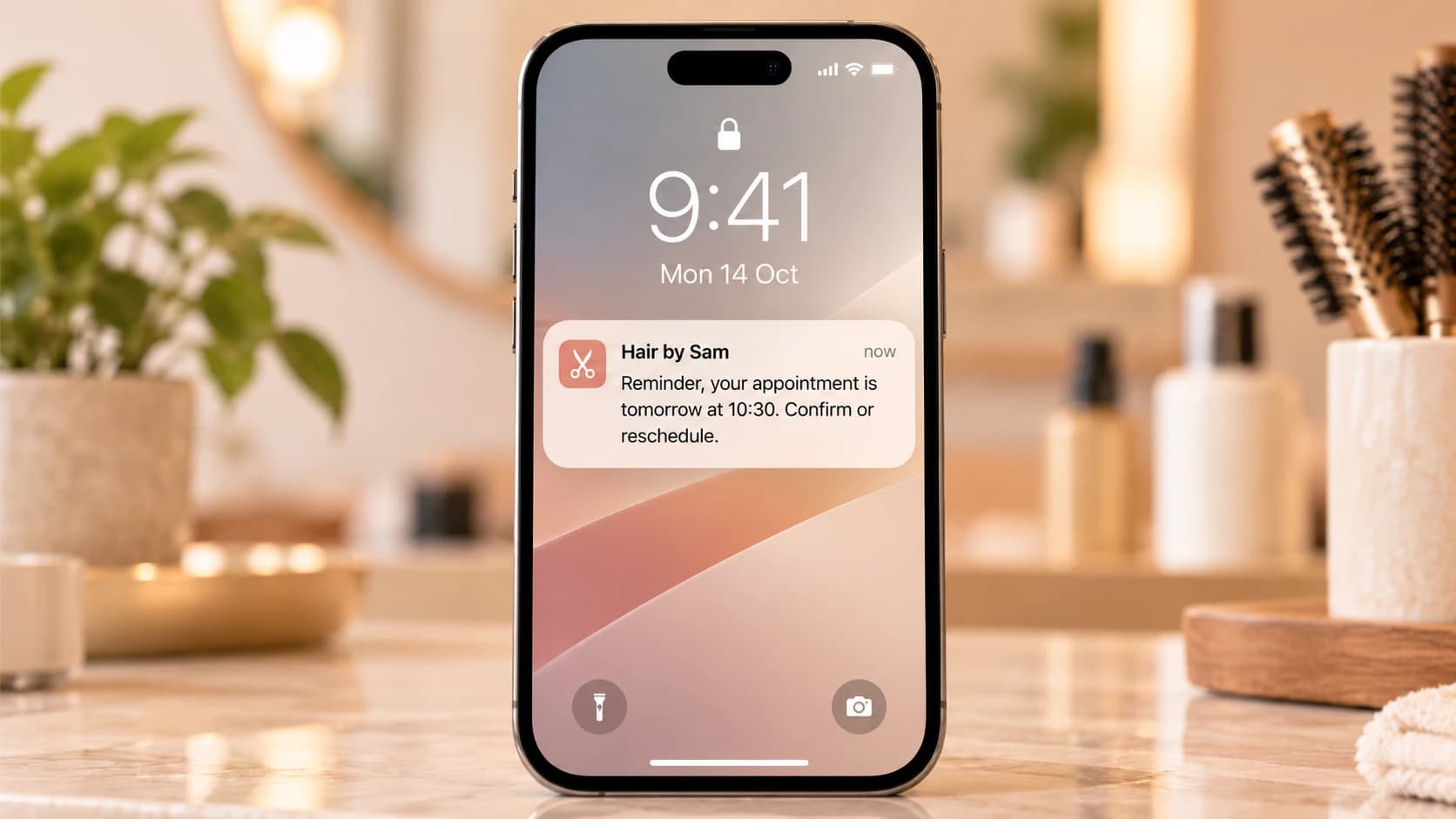
- Automatic reminders. A booking reminder goes out ahead of every appointment, a day before by default, or anything from one hour to two days. It's tried on WhatsApp first, with a text as a backup if WhatsApp doesn't arrive.
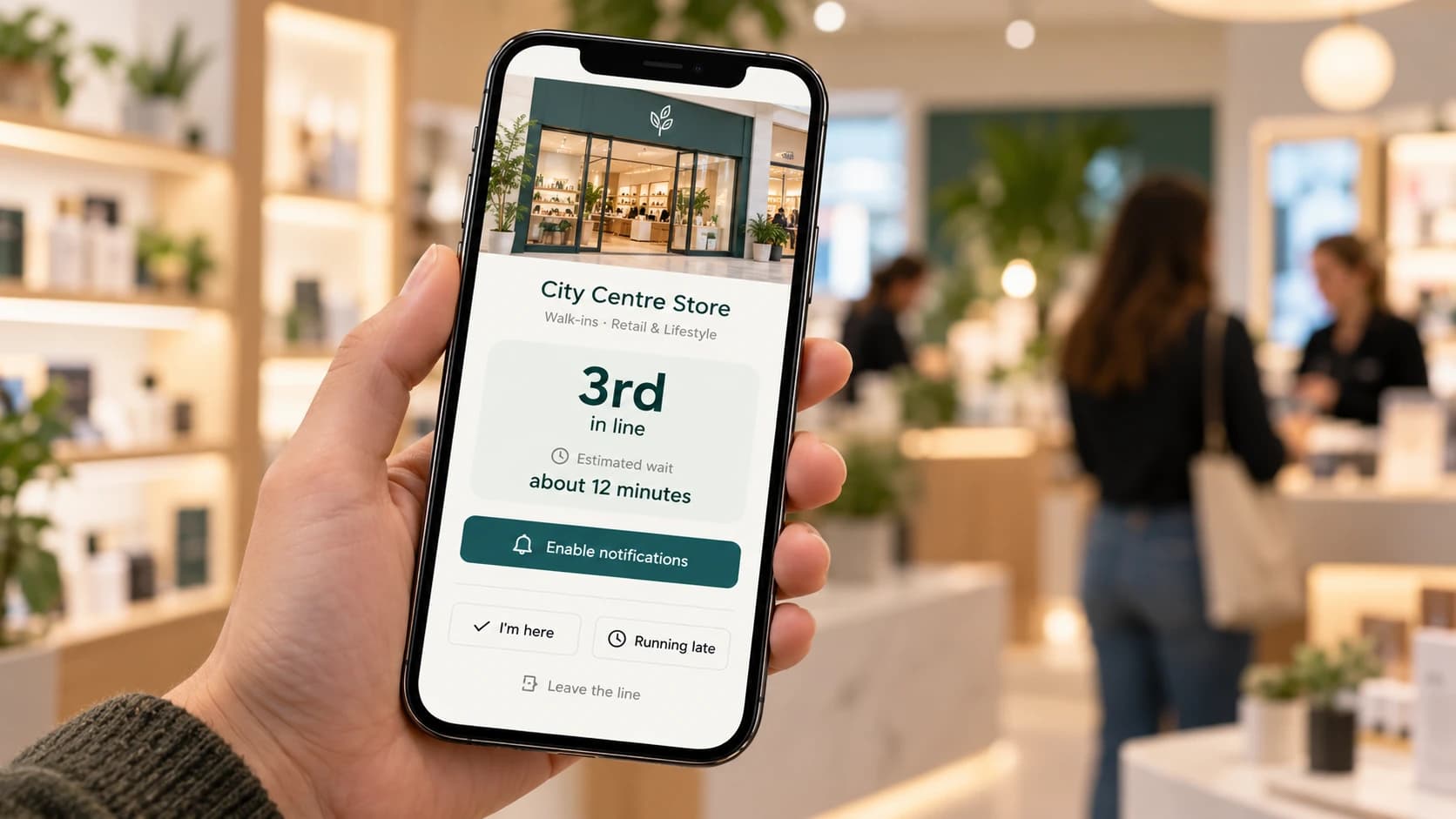
- Self-service cancelling and rescheduling. Each message links to the customer's booking page, where you can let them cancel, reschedule, confirm or say they're running late.
- Chasing and late nudges. Automation rules can remind anyone still unconfirmed before their booking, send a "running late" message when they haven't arrived, and mark a booking as a no-show after a delay you choose.
- A booking window. You set how soon and how far ahead people can book, and can cap how many bookings one person holds.
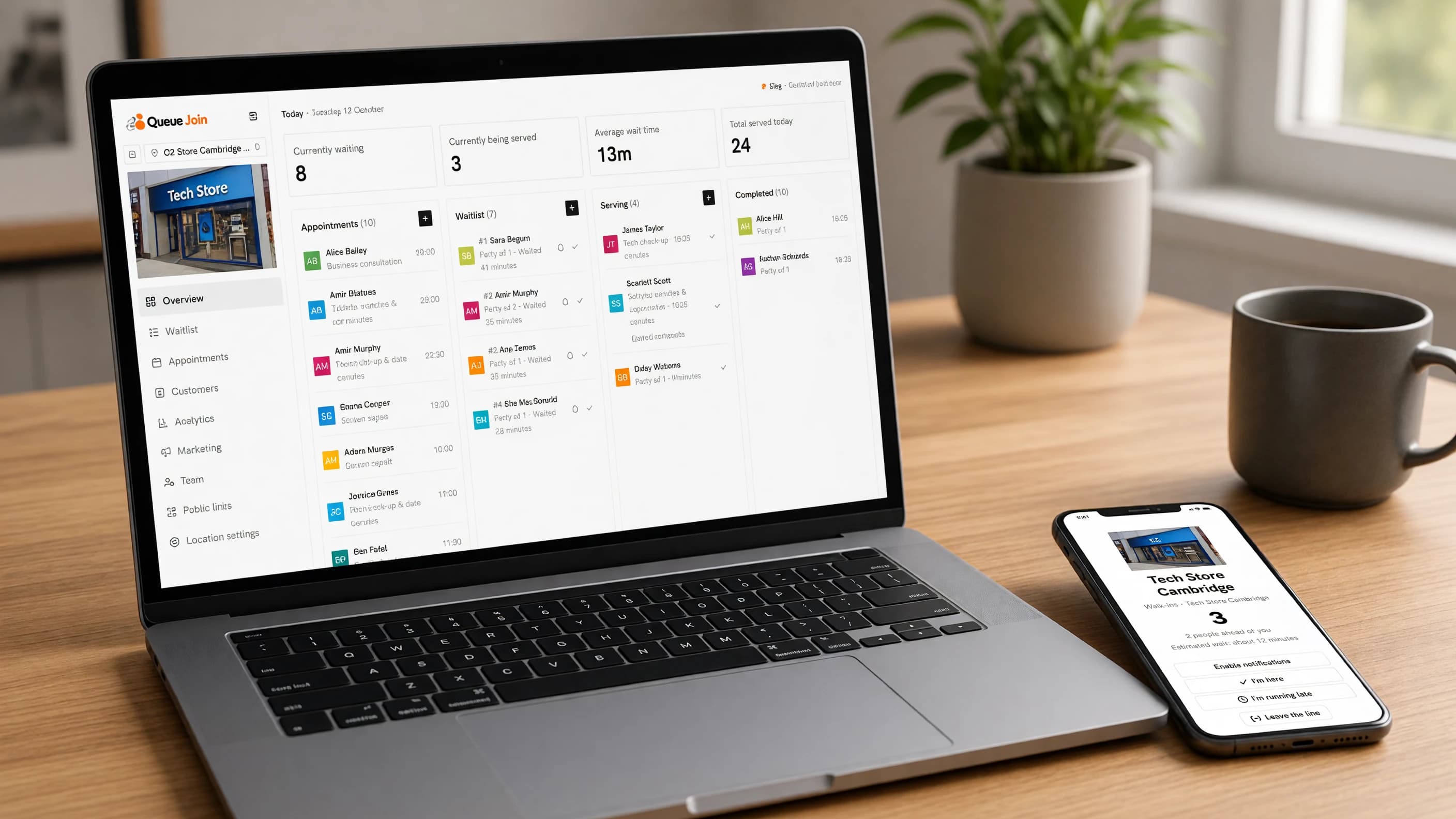
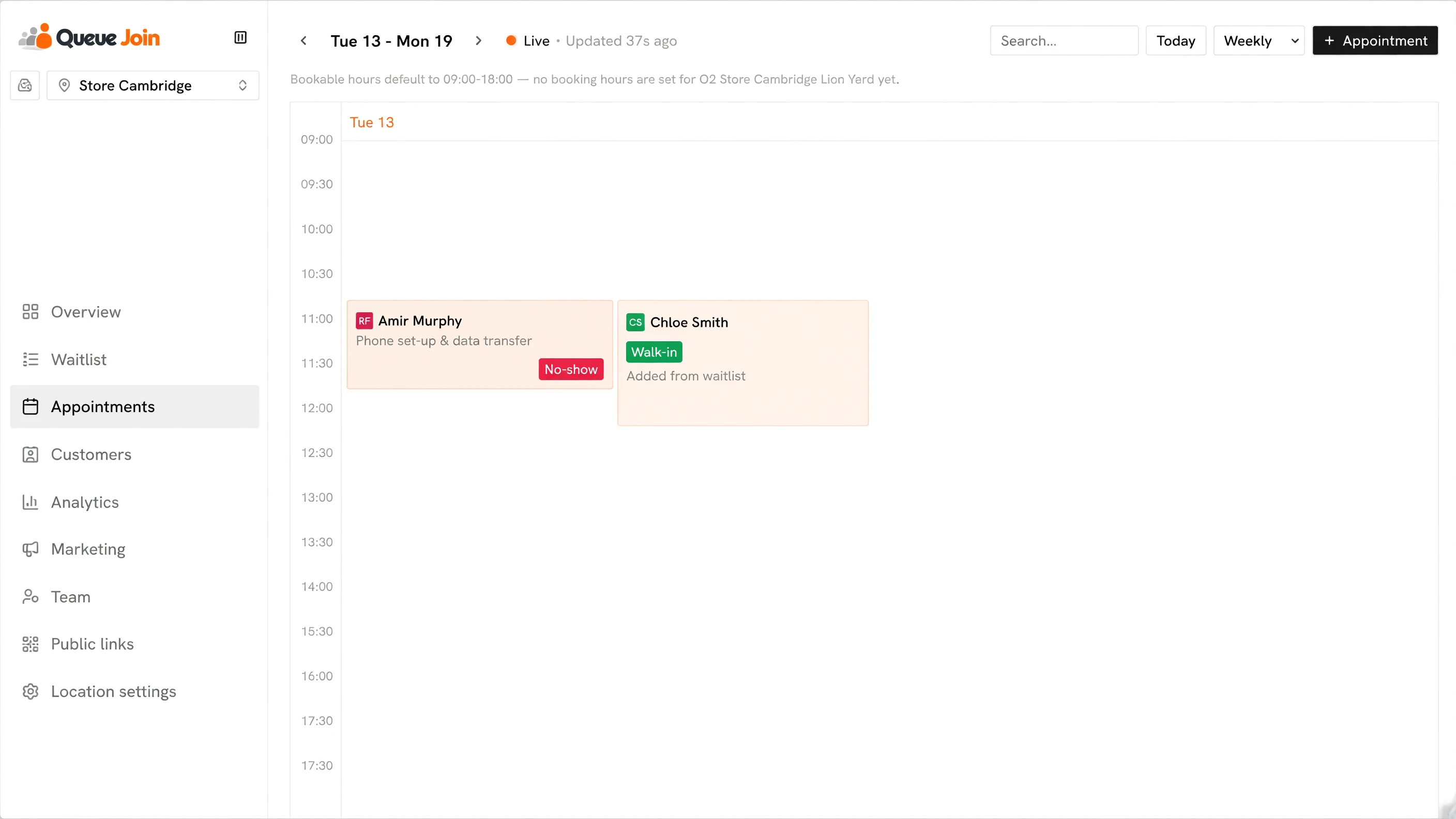
- Walk-ins alongside bookings. The waitlist and the appointments calendar run side by side, so a walk-in can take a slot a no-show left empty.
- History per customer. Every visit and booking is on the customer's record with how it ended, so repeat no-shows are easy to spot.
- Reports. On higher plans, an appointments report gives one row per booking for counting your monthly rate. See pricing for which plan includes it.
Queue Join doesn't take deposits or card payments for bookings. If you want those, use your payment provider alongside it.
FeatureAppointment schedulingLet customers book a slot instead of walking in, with timezone-aware availability per location.Learn moreThe appointments documentation covers how bookings move from confirmed to arrived to complete, and what each step sends to the customer. If you run a salon, see the page for barbershops and hair salons. For practices, there's one for healthcare clinics.
Frequently asked questions
Sources
- Dantas et al. — No-shows in appointment scheduling: a systematic literature review, Health Policy (2018)
- NHS England Digital — Hospital Outpatient Activity 2024-25
- Cochrane — Mobile phone messaging reminders for attendance at healthcare appointments (Gurol-Urganci et al., 2013)
- Stripe — Place a hold on a payment method (checked September 2026)
- Competition and Markets Authority — Wedding venues advised to play fair (2016)
- legislation.gov.uk — Consumer Rights Act 2015, Schedule 2
- CMS — MLN Matters MM5613: Charges for missed appointments
- Ofcom — Online Nation 2025 report

About the author
Chris Hunter
CEO and founder of Queue Join, writing about running waitlists, bookings and customer messages for businesses that serve people in person.
More about Queue Join